Emira Fresh Food
Pomegranate (Punica granatum) grown and packed in Türkiye — hicaznar from october, holding in store to february — deep arils, high acid, built for transit.

Pomegranate

Punica granatum

Hicaznar from October, holding in store to February — deep arils, high acid, built for transit.

HS code
0810.90
Varieties
4
Availability
Pomegranate. Available September to February. Peak September to November.

Fruits

Overview

Pomegranate is the strongest fruit position Turkey holds after citrus, and Hicaznar is the reason. It is a hard, thick-skinned, deeply coloured fruit that tolerates handling and long transit in a way that softer varieties do not, and it stores to February without controlled atmosphere.

The trade splits on acid. Hicaznar is a sour-sweet variety with 1.5–2.0 % titratable acidity, which is what the juice and processing market wants. Wonderful sits sweeter. If the enquiry is for eating fruit into western Europe, the answer is usually Wonderful or a late Hicaznar; if it is for juice or for the Gulf, Hicaznar main crop.

Husk scald is the disorder to watch on long holds. Our rooms run +6 °C rather than the +2 °C you might expect — pomegranate takes chilling injury below +5 °C and it does not show until the fruit is warmed at destination.

Nutrition claims

  • Contains naturally occurring polyphenols
  • Source of dietary fibre
  • Potassium contributes to the maintenance of normal blood pressure
  • Vitamin K contributes to the maintenance of normal bones

Wording follows EU Regulation 1924/2006. Confirm permitted claims for your destination market.

4 varieties

Varieties

Open a variety for full detail

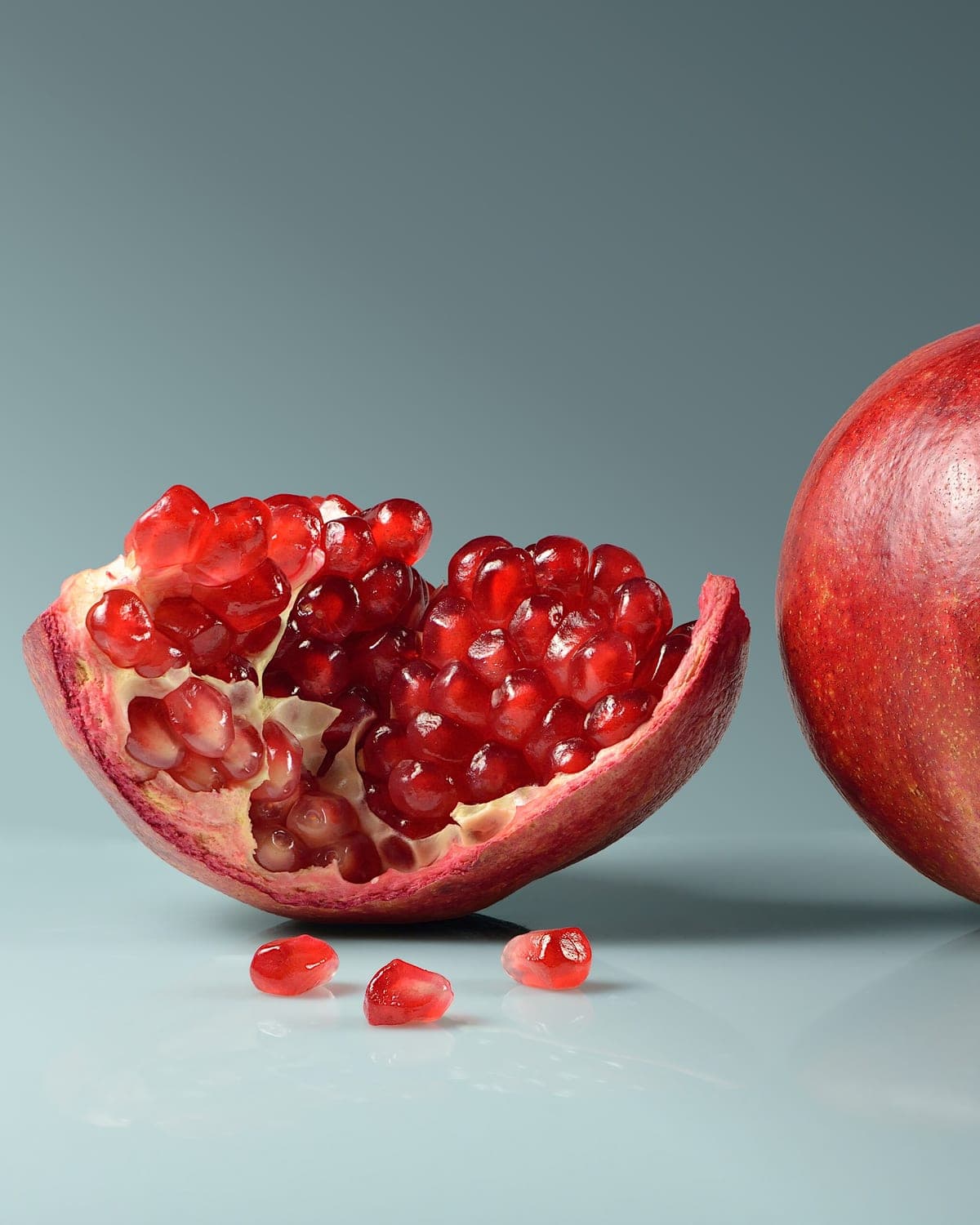
Hicaznar pomegranate — round, large, flat-crowned, deep red, thick hard husk

Hicaznar

The Turkish main-crop variety and roughly three quarters of national production. Large, hard-skinned, deep red inside and out, with dark arils and a firm seed. Sour-sweet at 1.5–2.0 % acidity and 15–17° brix. It is the best-storing pomegranate we grow and the standard for juice programmes.

  • Brix 15–17°
Shape
Round, large, flat-crowned
Skin
Deep red, thick hard husk
Notes
Titratable acidity 1.5–2.0 %; hard seed
Hicaznar. Available October to February. Peak October to November.
Wonderful pomegranate — round, medium-large, bright red, medium husk

Wonderful

Sweeter and softer-seeded than Hicaznar, with bright red arils and a thinner husk. Brix 16–18° against markedly lower acid, which makes it the eating variety for western European retail. Shorter window and it does not store as long.

  • Brix 16–18°
Shape
Round, medium-large
Skin
Bright red, medium husk
Notes
Softer seed than Hicaznar; lower acid
Wonderful. Available September to November. Peak October.
Katırbaşı pomegranate — round, large, pink to light red husk
Peak season

Katırbaşı

An early Turkish selection that opens the season in the first half of September, three to four weeks ahead of Hicaznar. Large fruit with a paler pink-red husk and lighter arils. Lower acid, brix 14–16°, and it is picked for the early market rather than for storage.

  • Brix 14–16°
Shape
Round, large
Skin
Pink to light red husk
Notes
Early variety; not a storage fruit
Katırbaşı. Available September to October. Peak September.
Silifke Aşısı (33 N 26) pomegranate — round, very uniform, deep red, medium-thin husk

Silifke Aşısı (33 N 26)

A Mersin selection grown mainly around Silifke, mid-early and notably uniform in size and shape, which makes it a good fit for count-graded retail packs. Deep red arils, brix 15–17°, moderate acid. Husk is thinner than Hicaznar so it handles less roughly.

  • Brix 15–17°
Shape
Round, very uniform
Skin
Deep red, medium-thin husk
Notes
High size uniformity — suits count-graded retail
Silifke Aşısı (33 N 26). Available September to November. Peak October.

Calendar

All varieties, month by month

  • Peak season
  • Available
  • Not available
  • Current month
Availability by product and month
ProductJANFEBMARAPRMAYJUNJULAUGSEPOCTNOVDEC
HicaznarFruits
WonderfulFruits
KatırbaşıFruits
Silifke Aşısı (33 N 26)Fruits

Origin

Where this crop is grown, and why it matters.

Sizes

Sizes

Grading follows UNECE standards. Other calibers on request.

Size grades and calibers for Pomegranate
SizesØ mmCount
A / 1≥ 1008–10 / 5 kg
B / 290–10010–12 / 5 kg
C / 380–9012–14 / 5 kg
D / 470–8014–18 / 5 kg
E / 560–7018–22 / 5 kg

Storage

Storage

Recommended regime from our cold rooms to your door.

Storage
+5 to +7 °C
RH
90–95 % RH
Shelf life
60–120 days
Ethylene
No

Transport regime

Reefer set +6 °C. Do not carry below +5 °C — chilling injury shows as husk scald only after warming.

Typical values per 100 g

Energy
83 kcal / 100 g
Vitamin C
10 mg / 100 g (13 % NRV)
Potassium
236 mg / 100 g
Dietary fibre
4.0 g / 100 g
Vitamin K
16 µg / 100 g

Indicative reference values. Not a substitute for a certificate of analysis.

Packaging

Packaging

Every option below ships on standard pallets. Net weight per container is computed from the pallet configuration.

Packaging options for Pomegranate
TypeNet kgDimensions mmPer palletPallets / 40′Net / 40′ kg
Open-top carton, single layer5400 × 300 × 1301442115,120
Telescopic carton10500 × 300 × 160802116,800
Wooden crate12600 × 400 × 180562013,440
Bulk bin3501200 × 1000 × 7801207,000

Container calculator

Select a packing option to see pallet configuration and net load for pomegranate.

Net weight per box
5 kg
Box dimensions
400 × 300 × 130 mm
Boxes per pallet
144
Pallets per 40′ HC
21
21
Total pallets
3,024
Total boxes
15,120 kg
Total net weight

Figures are for a standard 40′ high-cube reefer, single-stacked. Actual load varies with pallet type, chilling regime and destination weight limits — confirm on the quotation.

Ready to talk volumes?

Send us the products, months and destination — we come back with a quotation, not a brochure.

Request a quote